By admin, on February 3rd, 2015 If you’ve ever had a resume reviewed by a friend, professor, or career advisor, they may have added comments, made changes, or revised your document in some way. This feedback can be very helpful, but if you don’t remove those comments and changes, you may unintentionally send them to your prospective employer! (Just so you know, I don’t use the comment feature when I review your resume; I’ll send you a video review containing all my suggestions and revisions.)
When you open your resume file, you can choose “No Markup” in the “Display for Review” box, but that will only hide tracked changes temporarily; the changes have not been deleted, and they’ll show up again the next time anyone opens the document. In order to delete the tracked changes permanently, you have to either accept or reject them. If you’re ever concerned that some comments are still lingering on your resume, run Word’s Document Inspector. By the way, use this same tip to ensure your term papers and other class assignments are comment-free before you turn them in.
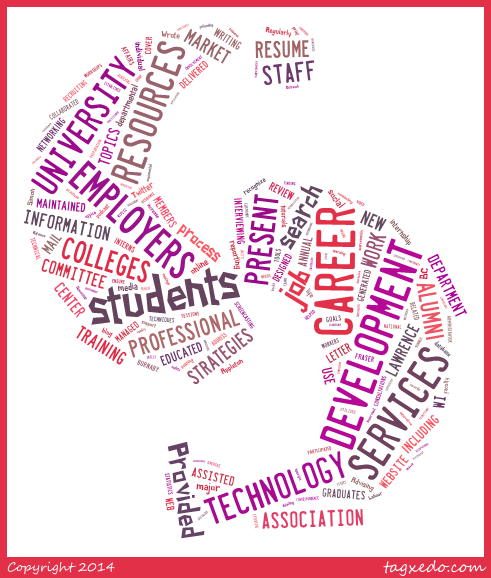
By admin, on January 7th, 2015  I’m sure you’ve seen word clouds before – you know, they’re those fun collages made up of words. Sites like Wordle, Tagxedo, and Word It Out, allow you to paste text into a box then generate a word cloud that highlights the most frequently used words in the text. (Some sites, like Tagxedo, even let you create a word cloud based on a specific shape – like the Sweet Careers logo!) I’m sure you’ve seen word clouds before – you know, they’re those fun collages made up of words. Sites like Wordle, Tagxedo, and Word It Out, allow you to paste text into a box then generate a word cloud that highlights the most frequently used words in the text. (Some sites, like Tagxedo, even let you create a word cloud based on a specific shape – like the Sweet Careers logo!)
Word cloud generators are also an easy, (and fun), way to check which keywords your resume, (or the job description for a position you’re applying for), is emphasizing. All you have to do is cut and paste your resume into the generator’s create box and click submit. The words that are the largest in the word cloud are the ones you’re using most. Are the biggest words the ones you expected? Are you using too many buzzwords, (e.g. effective, innovative, expert)?
You can also use a word cloud to analyze your LinkedIn profile. Be sure to let me know if you need help revising your resume or LinkedIn profile. Share your resume word cloud in the comments.
By admin, on November 18th, 2014  The holiday season can be a wonderful, joyous time for many. However, it can also leave people feeling overwhelmed, sad, exhausted, and lonely. If you’re feeling hopeless or depressed this holiday season, or any time of the year, please reach out. If you don’t have family or friends that you can contact, many university campuses have emergency/crisis hotlines available, and there are services in your community that can help, too. The holiday season can be a wonderful, joyous time for many. However, it can also leave people feeling overwhelmed, sad, exhausted, and lonely. If you’re feeling hopeless or depressed this holiday season, or any time of the year, please reach out. If you don’t have family or friends that you can contact, many university campuses have emergency/crisis hotlines available, and there are services in your community that can help, too.
If you are in the Fox Cities, here are some numbers you can call for help:
Outagamie County Crisis Intervention: (920) 832-4646
Winnebago County Crisis Intervention: (920) 233-7707 or (920) 722-7707
Calumet County Crisis Intervention: (920) 849-9317
Waupaca County Crisis Line: (715) 258-6304 or (800) 472-3377
Nationally, please call the National Suicide Prevention Lifeline: (800) 273-TALK or (800) 273-8255
You matter to me. I care about you.
God bless.
Image source: Freedom Institute
Crisis number source: Prevent Suicide Fox Cities
By admin, on October 6th, 2014  Question: I know this is dumb question but I dont understand what is internship? All my friends want to get internship and everyone know what is it. Am feel very stupid to ask anyone. I had part time job work in bookstore to help pay tuitions but is it same to internship? Do I need internship for my career? Thank you to your help to me it will be hard to ask my profs or friends. ~ Tatya Z., New York, NY Question: I know this is dumb question but I dont understand what is internship? All my friends want to get internship and everyone know what is it. Am feel very stupid to ask anyone. I had part time job work in bookstore to help pay tuitions but is it same to internship? Do I need internship for my career? Thank you to your help to me it will be hard to ask my profs or friends. ~ Tatya Z., New York, NY
Answer: I am really glad that you asked this question, Tatya. Although it may seem as though all of your friends know what internships are, you are not alone in wanting some clarification. Many students and employers still have some confusion about what internships are and how they are different from other types of employment or from volunteer activities. According to the National Association of Colleges and Employers (NACE),
Internships are typically one-time work or service experiences related to the student’s major or career goal. The internship plan generally involves students working in professional settings under the supervision and monitoring of practicing professionals. Internships can be paid or unpaid and the student may or may not receive academic credit for performing the internship. (Note: The issue of pay is dictated by the Fair Labor Standards Act.)
An internship is intended to be an intentional learning opportunity that would give you the chance to gain practical experience in your field while under the supervision of a professional within that field. This is different than, for example, your part time job at the bookstore because, while you may have learned many things, what you learned was not necessarily intentional. Moreover, your manager was not necessarily supervising you with the intent of helping you enter the fields of retail, book publishing, or purchasing.
There are many reasons that internships are so valuable. Aside from getting you practical experience, internships help you to test out a field while you are still a student and they give you the opportunity to begin networking with professionals in your field. Employers generally look quite favorably on applicants who have related internship experience. For example, a recent survey from NACE showed that employers made offers of full-time employment to 64.8 percent of their interns.
Please have a look through our Internship Basics articles where we answer questions like, Can I get paid?, When should I intern?, and Can I intern in the United States if I’m an international student?
|
A sample text widget
Etiam pulvinar consectetur dolor sed malesuada. Ut convallis
euismod dolor nec pretium. Nunc ut tristique massa.
Nam sodales mi vitae dolor ullamcorper et vulputate enim accumsan.
Morbi orci magna, tincidunt vitae molestie nec, molestie at mi. Nulla nulla lorem,
suscipit in posuere in, interdum non magna.
|
|